Showing posts with label Travel. Show all posts

Tuesday, July 19, 2011

Insert Famous Vietnam-based Robin Williams Quote Here

We're sorry, but we have to say it:

Good morning, Vietnam!

We're always scared first time we use a visa. Everything's been approved, but what if we've forgotten to do something somehow, or the policies have changed or they just plain don't like the look of us?

Going through border control is never a stress-free experience anyway. You do your best to try and look innocent, regardless of the fact that you are innocent, thus making you look and feel guilty. The smug security personnel that enjoy asking you questions just to make you sweat and induce a mild sense of guilt never help either. They know what they're doing and they love it.

This is all a red herring though as we passed through into the arrivals gate of Ho Chi Minh City Airport with no issues whatsoever. To get into the centre of what was formerly known a Saigon, we caught a local bus. This involved our first transaction using the Vietnamese Dong (teehee) and immediately caused confusion. Sat on the bus with our backpacks on the floor, the driver asked us for D16,000. This was D8,000 more than we were expecting and we refused to pay and left the bus. It was only when we were back on the pavement that we stopped and did the maths: with £1 equivalent to D32,847, we had walked away over a matter of 25p.

In our defence though, with such an obscure number and five figures to the pound, converting the currency back wasn't the easiest task in the world and was obviously going take a bit of getting used to. Plus, when we got on the next bus, we were only charged D8,000, so we won out in the end (and were 25p richer).

Off the bus, we wandered around HCMC's equivalent of Kho Shan Road, Pham Ngu Lao, and eventually found Mai Pai Hotel, where we spent two nights. It was around 8pm by the time we'd dumped our bags down and freshened up, so we hit the streets in search of food. In a small restaurant surrounded by locals, we got our first taste of Pho Bo - a tasty noodle soup with greens and beef. Richard arrogantly piled in the chillies, only to pick them out minutes later whilst trying to douse the fire in his mouth with a Saigon beer. Nonetheless, the meal went down really well, as did the price. D114,000 for two big meals and two large beers, or a little less than £3.50.

We spent our only full day in HCMC visiting the War Remnants Museum, which catalogued and presented Vietnams involvement in the Vietnam War. We like to walk as much as possible, partly because we're tight-fisted travellers, but mostly because you're able to take in and notice a far greater amount of your surroundings when you're wandering past it than you would if you're flying past it in a taxi.

We stepped onto the streets of HCMC heeding the warnings we'd received from others who'd visited Vietnam about the traffic. The roads are full of mopeds. In fact, we've never seen so many in one place and hundreds of these little two-wheelers buzzing past you, coupled with the cars, made crossing the road a potentially daunting prospect. Thankfully, Indian traffic, a law unto itself and rarely following any sort of uniformity, had adequately prepared us for walls of honking vehicles and we were able to walk into the traffic with a fair amount of confidence that it would part around us. 

The many mopeds of HCMC
Back to the War Remnants Museum, only briefly before we take another quick detour, we managed to turn up just as the gates were closing for lunch. Somewhat naively, we assumed such a prestigious museum would be open all day and so we were left with an hour or so to burn. We wound up in a cafe, which had free wifi (abundant across SE Asia it would seem), glasses of free iced Jasmine tea, which were topped up non-stop, and incredible iced Vietnamese coffee.

Vietnamese coffee deserves a write-up of its own on account of its utter brilliance, but we'll make do with a paragraph. Served in a small tumbler glass, the shot of the dark, thick coffee is so strong it almost tastes alcoholic. It's great on its own, served on a couple of cubes of ice, but most Vietnamese opt for the sweeter version, which adds a dollop of condensed milk. It. Is. Glorious. 

This was outrageously addictive
Second time lucky, we entered the War Remnants Museum, passing countless tanks and helicopters from the war as we made or way up the stairs and through the entrance. The museum was fantastic and incredibly insightful, especially given our levels of ignorance on the subject. It was, however, insanely biased and bordered on propaganda. Our levels of knowledge on the Vietnam War are still far from expert. We are also very aware of how controversial an invasion Vietnam was and we are not for a moment suggesting America were in the right. However, we know enough to be sceptical of the fact that the portrayed attitude of "we were just doing our thing and minding our own business until the Americans showed up and started kicking up a shit storm" doesn't tell the entire story. A couple of other interesting points we picked up along the way were the fact that, in Vietnam, they refer to the conflict as the American War and that America's controversial decision did France a pretty big favour.

Front of the War Remnant's Museum
All of this said, there were parts of the museum that couldn't be tainted by bias. The first of these was the Requiem Exhibition, a collection of photographs taken by war photographers from around the world and compiled by Tim Page, a frontline war photographer himself The images displayed around the room, portraying scenes of extreme violence, burning villages and death, didn't require any accompanying text. Likewise, the section of museum devoted to the after effects of the chemical used to wipe out forests and pollute water supplies in order to chase out and expose guerilla militants, Agent Orange, was also heavily image dependent. Tens of photos showing children and adults alike, all of whom are later generations of those that fought on both sides during the war, that have suffered birth defects as a result of the chemical. Some of the photos were pretty harrowing. 

One of the many anti-war posters
We came away with our ignorance fully exposed, which was actually quite refreshing. It's outrageous to think that such an enormous event took place in recent history and that, probably in part because we weren't directly involved, it doesn't really fall as heavily under our radar.

The remainder of our time in Ho Chi Minh City was spent traipsing around Chumpon as we tried to find some temples that were supposedly ten minutes from the bus station. We eventually found them three hours later, but were so wet from the starting-and-stopping rain and miserable from being lost for so long. As a result, we probably didn't appreciate them as much as we could have, but they were still nice places to escape the wetness. 

Inside one of the elusive temples
Our mode of transport from the bottom of Vietnam to its top was a sleeper coach, which we booked through a company called Sinh Tourist. For £22 each, we bought a ticket that allowed us to get a coach from HCMC all the way up to Hanoi. This was 1,657km away and literally took us from one end of the country to the other, with stops in Nha Trang, Hoi An and Hue on the way. The ticket included three overnight journeys and one day journey on a sleeper bus where you essentially had a small bunk for the night. All we had to do was book onto the coach the day before it was due to leave. Admittedly it wasn't the best nights sleep we've ever had, but it was amazing (and insanely cheap) nonetheless. What's more, after our rather unfortunate experience with the coach company in Surat Thani, this was incredibly simple. 

On the (overnight) buses
We arrived into Nha Trang early the following morning and as we pulled in we discovered that Vietnam gets up very early. As we drove past the beachfront at 5:45am, we gawked at the countless numbers of locals sitting around and chatting, walking and playing badminton. On arrival, we checked straight in to Backpackers House. After enjoying Spicythai so much, we wanted to spend a few more nights in a dorm. We checked in, giving our details to a receptionist who refused to reveal even a hint of a smile, but decided that because it was still so early we would do the courteous thing and wait a few hours before we went and made noise in the dorm. We therefore went for a spot of Pho Bo and cold coffee in the attached Red Apple Restaurant. The following morning, we discovered that we're obviously far too British. Those that had come in on the early coach had chosen to come straight up into the dorm, meaning we were woken up at 7am by an Australian guy talking far too loudly about happy endings. The place was also right above a club, which meant an overall lack of sleep, even after a few cocktails at the Green Apple Club. Maybe we're getting old.

Nha Trang's Beach
Partly because of the above and partly because the crowd of people at the Hostel were pretty boring (particularly two girls that walked around with faces like slapped arses the entire time - more on them later), we decided to move to a private room at Phu Quy, which actually turned out to be cheaper and so we were more than happy.

Nha Trang is somewhat renowned for its partying and its beach, but we weren't actively seeking big nights out and so we gave the towns reputation a knowing hat tip with a few beers and some cocktails instead. Our favourite watering hole, and what quickly became our local for the few days we stuck around, was Louisiane Brewhouse, a bar which had its own pool, whipped up cute little cakes and poured amazing microbrewed beers made on site. The passion fruit beer was particularly delicious. The pool made a nice change from the beach, as the sea wasn't really enjoyable to be in on account of the beach being on a slope. This meant the waves would collapse in on themselves and have you constantly trying to regain your balance.  

Not the only Passionfruit Beer Richard had
We also found some lovely places to eat. La Veranda was a little restaurant with wifi that served tasty, high-end-style food and amazing iced coffee for miniscule amounts. Whilst La Veranda was our lunchtime haunt, Lanterns was where it was at for dinner. With profits supporting a local orphanage, we were able to chow down with a conscience on seafood hotpot and chicken in a coconut, both of which were superb.

It's not all cocktails and cuisine in Nha Trang. It has quite a bad reputation for petit crime, with bag snatching and muggings ranking amongst the most common. With drunken travellers stumbling the streets late at night, it must be like shooting fish in a barrel and, thankfully, we didn't witness and were not party to any of this. However, we did witness something far worse. At around 2pm, as we were lying on the beach, a scuffle broke out next to a children's playground amongst a group of local men. We looked on and it began to escalate quickly, with arms and legs swinging aggressively and more people becoming involved. It all culminated in three men riding away on a motorbike, the man in the middle sandwiched between the drover and the passenger as we limply swayed from side to side. In all the commotion, he'd been stabbed - over what, we still don't know. We continued to watch as everyone involved scattered in various directions and the police casually arrived and did next to nothing. We were told the stab wound wasn't fatal, but the blood on the pavement was more than a few drops.

We should stress that this is a rarity and you shouldn't let this put you off visiting Nha Trang. It's a great place and well worth a stop on your way up the Vietnamese coast.

Our next stop, Hoi An, quickly turned into our favourite place in Vietnam. A UNESCO World Heritage Site, the city used to be a trading port back in the 17th Century. Thanks to its UNESCO status, the it has changed very little in the last one hundred and fifty years, with its Chinese, Japanese and European influences still there to be seen in abundance. The city was absolutely beautiful, its streets lined with old yellow buildings, many of which were covered in climbing pink flowers, and it was lit up at night by hundreds of lanterns. A river ran through of the the centre of the city and here you could go and light candles in lotus flowers for good luck as you walked along its banks after dinner, listening to he classical music that played over the city-wide PA system. 
Hoi An's bridge by night
Wandering the streets of Hoi An

We stayed in Hoi An for four nights, although we could have happily doubled this, at Nhi Trung Hotel. The hotel was probably the best we stayed in in Vietnam and was up there in one f the best places we've stayed since starting or travels back in February. For less than £10 a night, we had a comfortable, quiet room with air-conditioning, satellite TV and free wifi. Whats more, hotel staff came into our room every day not only to clean and make the bed, but to give us fresh towels, toilet roll and toiletries! This is highly unusual in budget accommodation. In most cases, we're lucky to get a couple of towels and half a roll of loo paper, so imagine or excitement when we were give fresh soaps, toothbrushes and a comb each day. How decadent.
Hoi An is not only famous for its lanterns. It's also infamous for its tailored suits. There were literally hundreds of tailors lining Hoi An's streets and everyone wanted you to come into their shop for a look. As our hotel had an affiliation with a tailor, T&C, we decided to go and have a chat to them about what we were after. They turned out to be very professional, meaning we didn't have to traipse around countless tailors, and for £150 Ashley had a suit skirt and jacket, as well as a suit dress made, whilst Richard went for four shirts. 

Lanterns, lanterns everywhere...
We were measured at 4pm on the day that we arrived, choosing our materials and fabrics. At the same time the following day, the 'first draft' of our clothes were already ready to be tried on. We tried them all on and were drawn all over in chalk as try established where things needed to be taken in and out. On the third and fourth days, Ashley had two more fittings just to make sure her suit was perfect an it was. We were both incredibly happy, especially Ashley, who even got to pick the lining of her suit and dress - a pretty, flowery silk.

As a UNESCO site, Hoi An contains some incredible, well preserved buildings. We spent a day wandering around these sites using the 'Hoi An Old Town Pass', which allowed us to pick five sites to visit out of nearly twenty. First was the four hundred and eighteen year old Japanese covered bridge, which contained a small temple and was guarded stone by dogs on one end and monkeys on the other (because its construction began in the year of the dog and ended in the year of the monkey). We also took a look around the Assembly hall of the Fijian Chinese Congregation, a meeting hall-cum-temple, and Phung Hung Old House, a exquisitely and ornately decorated building. We finished the afternoon off with a cultural performance at the Museum of Trading Ceramics, where we watched men and women dance, sing and slap bass. 

"Slappa da bass BIG TIME!"
With its reputation for local specialities, eating in Hoi An was a constant treat. There were fried Hoanh Thanh (wontons), White Rose (prawns in steamed rice paper), Banh Xeo (crispy savoury pancakes filled with herbs) and, our hands down favourite dish of Vietnam, Cao Lau (thick, flat, doughy noodles in broth served with Vietnamese-style croutons, bean sprouts, greens and slice pork. The latter was unbelievably good and we ate it at least once a day.


We ate far too much Cao Lau
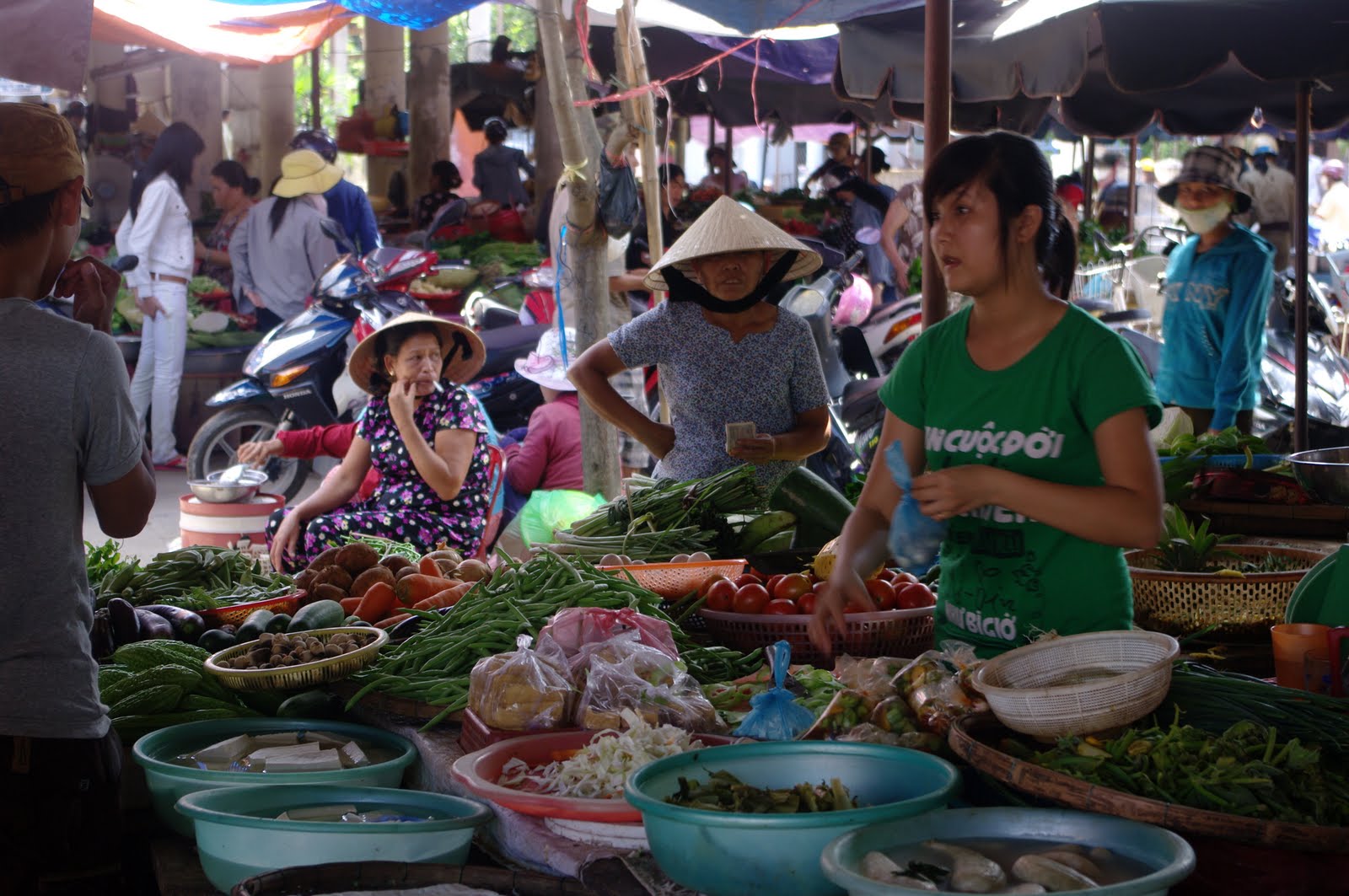
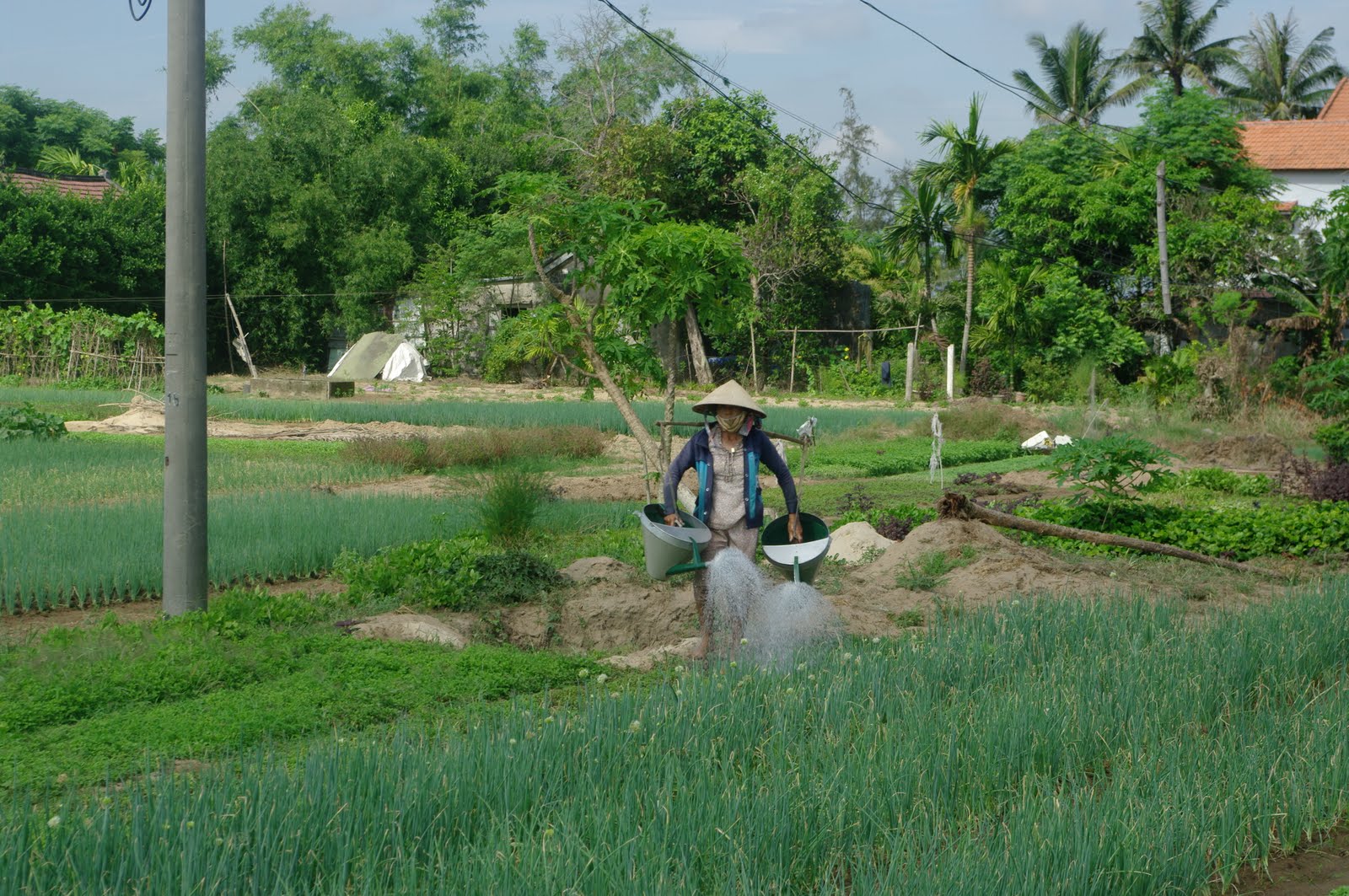
With such a diverse and special menu, this was the place to do a cooking course and so we spent a day at Red Bridge Cooking School. We were taken to an organic herb and vegetable farm where we picked up many of the days ingredients, as well as enjoying a cold and refreshing lemon-basil seed drink, before picking up the rest of our ingredients from a busy local market. From there, we were driven to the school and were given our own private lesson for the day as we learned to cook Pho Bo, marinated, barbecued prawns (one to be repeated in the summer - incredible), clay-pot fish and banana flower salad (fantastically fresh and zingy). As always, we were able to eat everything we made, taking as much Beer La Rue as we fancied for no extra cost and finished our day off with a swim in the pool. Full, we thanked our chef and were taken back to the main area of Hoi An along the river in a boat - a perfect end to an excellent day.
Watering the herbs and vegetables
At the market
Ashley whipping up some claypot fish
One of our favourite dishes of the day: banana flower salad
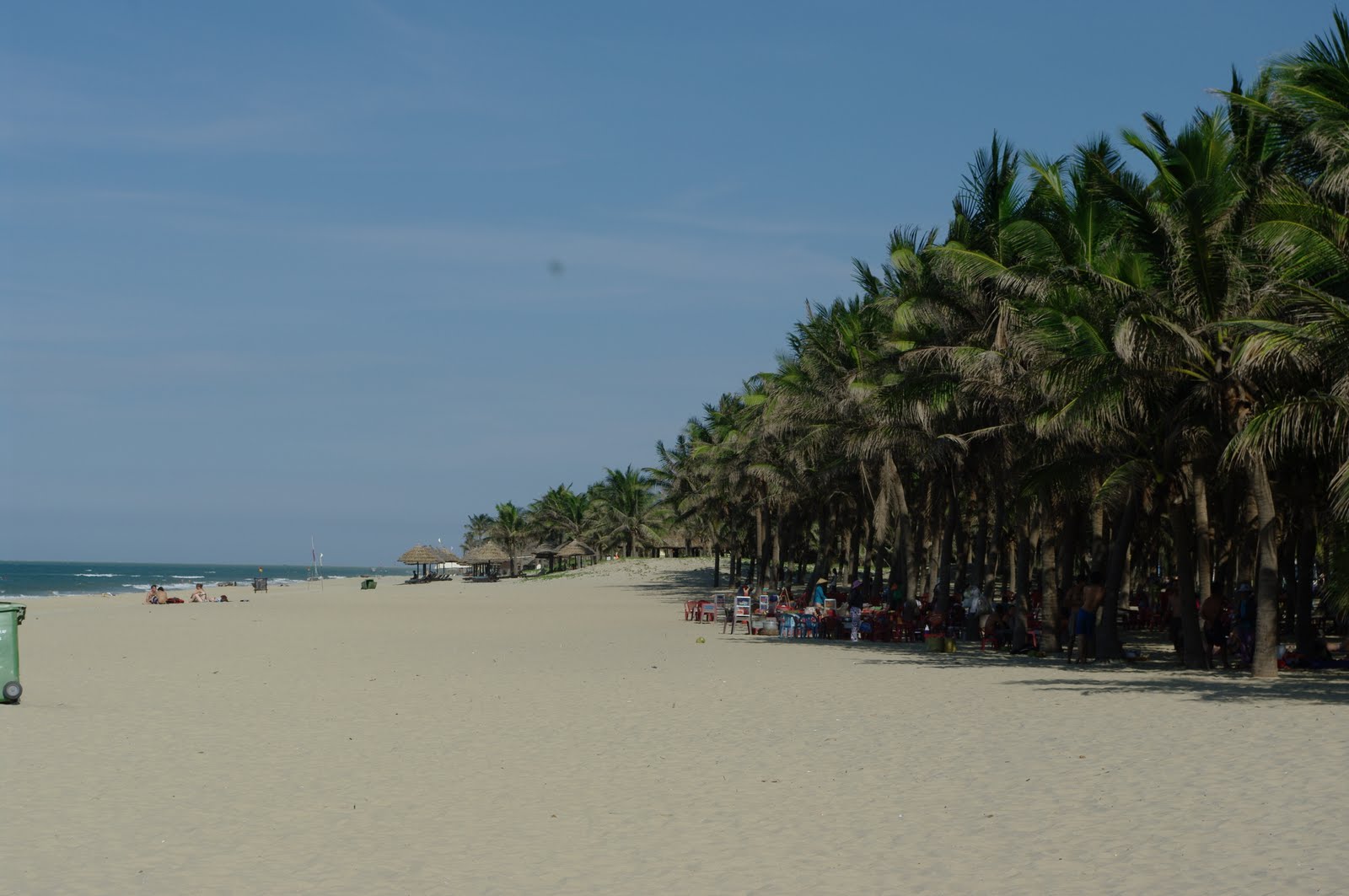
As if all of this wasn't enough to keep us busy, we also hired a bicycle for the day (60p per bike) to visit Cua Dai Beach. The cycle was flat and relatively easy, if you discount the road works we had to work our way around, and the stretch of beach it led to was beautiful, with deck chairs under thatched palm shelters and a calm sea for cooling off in. It was without doubt much nicer than the each in Nha Trang. On the way back to the hotel, we indulged in one of our now regular habits/pastimes - cafe visiting. Dingo's was run by a couple of Australian expats and served up delicious slices of cake (the lemon tort was particularly delectable). With our now international knowledge of cafe's, if all falls through on the job front, cafe critiques could present itself as a serious and very probable career path.

Cua Dai Beach
Cycling home (check out the basket)
An early, four hour bus moved us on to Hue, where we had much better luck with a Backpackers Hostel. Hue Backpackers was a friendly, Australian run place that had it completely right. Clean dorms, clean bathrooms, a social area upstairs and a bar and restaurant downstairs. Dave, the manager, was always around, seemingly propping up the bar a lot of the time, especially between 5 and 6pm when it was two for one beers - two for D20,000 (60p). Richard got chatting to him one evening and, between the free Snickers and rice wine vinegar shots he was dishing out, Richard asked him a few questions about the hostel. Apparently they are almost always operating at 80% occupancy, where as most other places operate around 30%. As a result, a lot of the local hostel owners didn't like Dave. He'd even received death threats. 
We only spent a couple of nights in Hue, but managed to squeeze in a day on a moped, riding to the Tomb of Tu Duc and the Tomb of Minh Mang. Whilst Tu Duc's tomb was relatively easy to find, we spent the rest of the day looking for the second. Both tomb's were very impressive, more for the grounds than anything else. Tu Duc's tomb was set along a small lake and surrounded by pine trees and Minh Mang's was hidden behind series of walls and bridges each intricately and individually designed. They were both peaceful places to spend the day quietly and slowly walking under the intensely hot sun. 

Pagoda where the King's concubines would hang out
The bridge to the Tomb of Minh Mang
A small shrine and its offerings
We also spent a day on the other side of the river at the Citadel. Whilst not quite as impressive as the tomb's due to the fact that it was bombed intensely by the American's during the war, the Citadel is still an impressive series of buildings, many of which have been or are being renovated or rebuilt from scratch where they once existed. 
Inside the crumbling Citadel
Our last official stop on the Sinh Tourist route was Vietnam's capital, Hanoi. With the same hustle and bustle as Ho Chi Minh City, Hanoi is a amalgamation of small windy French-style streets filled with fantastic little boutique shops, tourist toot and restaurant. It has has some great street food on offer. On our first night, we passed a restaurant filled with locals, all of whom were sitting on the outdoor plastic chairs you buy for children - the only kind of street food stall seat available in Vietnam - and tucking into a good-looking hot plate. We decided this was the place for dinner and, with a metal plate on top of a flame, we cooked the enormous plate of marinated raw beef, onion, peppers and tomato we were served. It was delicious, made even more so by the restaurants unexpectedness.


This was glorious
Hue backpackers was part of a small group of hostels, with the headquarters being in Hanoi. Having enjoyed our stay in Hue, we went to the Hanoi arm where we stayed for a night and booked onto the three day, two night tour of Halong Bay.

The tour started early the following morning with roll call and distribution of brightly coloured sombrero's at 8am. Richard's wake up wasn't ideal. Our room mates had come in pretty late the night before and had made a considerable amount of noise, drunkenly 'whispering'. Bleary eyed, Richard rolled over in the morning to see the guy on the adjacent bunk asleep with his back to him, duvet off and trousers half way down towards his knees with his hairy arse pointing straight at him. It was not the most ideal way of starting the day.
We were herded onto two mini buses for the four hour drive from Hanoi to Halong City. On the drive we were sat next to Alice and Marius. Alice was from the UK, had been travelling for four months around Africa and South East Asia and was heading to University in September. Marius was from Germany. He had been travelling for eleven months, eight of which were spent in Australia and the rest of which he'd used to explore South East Asia. Whilst a nice guy, he was a bit of an odd one. More on that in due course.

We stopped for a break at a pottery shop, which no one was interested in looking around. In fact, they probably made more money from selling Pringles and pop than they did on the overpriced jewellery and over-sized ornaments. Anyway, we were supposed to stop for fifteen minutes to give us time to feed, water and drain ourselves. We were starting to get a little restless when forty minutes later, when we had all crowded outside the bus waiting to carry on with the journey and yet to moved. Eventually, Andy, our crew member, informed us that there was a problem with the boat we were supposed to be boarding and spending the night on. In fact, there was a problem with all the boats. Every single boat driver on the bay had chosen to go on strike, meaning we couldn't get out on it. Initially, we thought he was pulling our leg, but we quickly had to make a decision on whether to carry on to Halong City to see what the situation was when we arrived or to turn around and head back to Hanoi.

We all deiced to at least head as far as Halong City and see if the situation would improve in the couple of hours we spent getting there. When we arrived, nothing had changed and so, over lunch, we had to make the decision on whether we wanted to head back to the hostel and get a full refund or go ahead with the alternative plans the crew were making. With no time to do this again, Ashley and I decided to go for it, as did quite a few others To be honest, we still had a great group, we just lost a lot of the more boring types who were putting a dampener on the day already (including the two -faces-like-slapped-arses girls from Nha Trang). We had a some lunch, which Marius made rather uncomfortable by waving several king prawns, complete with black beady-eyes, whiskers and heads, in the face of his vegetarian neighbour. He also ate half (as in one full side - a whole fillet!) of some delicious fish that was meant to be able to go round a table of ten people. Richard was not best pleased.

The new plan for the day was to get a ferry, which was the only boat still operating, to Halong Bay's largest island - Cat Bha. Here, we visited a beach that was full of Vietnamese and which, apparently, no Westerners had ever been to before. Feeling privileged, we all enjoyed a well-deserved beer, a dip in the sea and a Vietnam vs Rest of the World football match (the last one was just the guys). We were then bussed to our alternative accommodation for the night and we have to say that we kind of lucked out! We arrived just after nightfall at what was clearly a very nice resort, with beautiful rooms and in the middle of nowhere. Granted, we had to share with a few other people on account of there being a lot of us, but it was still pretty swanky. We felt a little bad when we all gathered in the bar area and saw a middle-aged couple, clearly on a romantic and private getaway, wandering through the courtyard. You saw their faces drop when they saw that thirty or so backpackers had come to destroy any hopes they harboured of an isolated evening on an island.

On our way...
...to Cat Bha island
During our tasty dinner, we sat next to our new source of entertainment (for all the wrong reasons), Marius, who once again came out with a question that was awkward, entertaining and ominous in equal measure. As he got to know the girl opposite him, Dominica, it came up that one of her parents were Israeli.

"Are you Jewish?", ventured Marius suddenly.

"Yes, on my Mum's side", she repiled. At this point, Marius raised his finger and wagged it in her face and said (read this in your best German accent):

"Don't come to Geerrrrmannnnyyyyy".

We all broke out laughing, but what an outrageous opening gambit.

After dinner,  the drinks quickly started to pour and the subsequent drinking games ensued. Split into two teams, us on Team Ghost Panther with a few people we'd met along the way (Lucy from the UK and Domenica and Fran from Australia), Ring of Fire began. Once we realised the cost benefits of buying and splitting a litre of vodka rather than continually buying doubles, things really took off and the night got pretty hazy from there on in. Moments of clarity still arise: unbelievable amounts of lunging, Richard getting behind the bar several times, Richard trying to get onto the bar, the two of us swapping clothes, excessive levels of dancing and Ashley biting someones nose (part of the drinking game and not a random attack).

The following morning we, Richard in particular, were reminded why we hadn't been drunk for the last few months. His head was throbbing, he struggled to see, his stomach was somersaulting and the sun was already beating down intensely at 8am. This was all intensified as we got onto a boat to takes us the Hostels very own, private island: Castaway Island.


The largest floating village in Halong Bay
Richard feeling a little worse for wear
We arrived on Castaway Island
And this is what we had at our disposal
As we worked our way through Halong Bay, past the floating fishing villages and infinite number of limestone islands (three thousand in total), we marveled at its magnificence. How did this place ever come to be? After about forty minutes to an hour on the boat, we pulled into Castaway Island, a beautiful and secluded little cove in the middle of Halong Bay where we spent the next twenty-four hours. The first thing we, and pretty much everyone else, did was get in the sea to cool off. Our day in paradise started as it meant to go on and we switched between the sea and the sand, mixing in some wakeboarding in the bay (Richard stood up and Ashley was really close) and exploring the neighbouring islands in a kayak. Needless to say, this was a real highlight of Vietnam.
Richard made it up a couple of times
Ashley came oh-so close
 After a day in the sun and some dinner, the drinking games began in earnest once again. First up was Roxanne. This amazing Police track began to play and each time Sting sang "Rooooooxanne", the girls would take a drink. Each time he crooned "put on your red light", the guys would have to take a drink. With Beer Ha Noi as our drink of choice, we finished the warm-up bloated and feeling slightly abused. Next was Roxanne's bigger and meaner older brother: Queen's 'Bicycle Race'. Each time Freddy Mercury ventured the words "bicycle", we were treated to another glug from our can. If you're not familiar with the song, or if you haven't heard it in a while, he says the word bicycle a hell of a lot. The evening stared to descend into messiness and, whilst involving ourselves, we sensibly chose to take a backseat.

Throughout the night, there was an ongoing game taking place called 'Buffalo'. It was, at least in theory, a simple game in which you could only drink with your left hand. If you were caught drinking with your right hand, someone would shout "Buffalo" and you would have to finish whatever it was that you'd chosen to drink. No one really took this game that seriously as it was pretty annoying having to finish, say, a full can of beer. No one, that is, except for Marius. Throughout the night, as people innocently sipped at there drinks, he would be watching everyone around the table like a half. Every so often, a German-infused voice would break the festivities and you were hear (again, read in your best German accent):

"Buuuffffffalllooooooooooo".

He really was quite a character.

At around 1am, Ashley and I went for a dip in the sea and, as we swam around in the water, our moving limbs were surrounded by what looked like tiny LED's. The water was filled with phosphorescent algae and watching it was incredible. It was a prefect way to finish our few days in Halong Bay and, with that, we headed back to our mattress, which was with about ten others and underneath a thatched roof with open sides, each bed surrounded by a mosquito net. It was rather idyllic.

The next day was spent travelling back to the hostel, where we stayed one more night and went out for an superb dinner. Quan An Ngon served up street food-style food, but in a setting suitable for the Viatnemese middle classes. Set in a well-lit, busy outdoor 'garden', we tucked into a beautiful seafood hotpot for two. A fitting, although it turns out rather premature, 'last meal'.

The following morning, we caught an airport bus to take us the one hour drive to Hanoi airport where we'd fly on back to Singapore and then on to Delhi. Almost robitically, we handed our passports over to the airline representative who spent a little longer than normal tapping away at her computer's keyboard. We weren't that phased as, on all of the tickets we have booked, Ashley's surname is spelled incorrectly so there can sometimes be a bit of mild confusion. Ater a couple of minutes, she asked to see our e-tickets and, once we handed them over, we were told what the issue was: we were a day early. 

Ah. We quickly put a positive spin on what was a bit of a pain in the backside - at least we were a day early rather than a day late. We could just come back tomorrow and try again. It was actually a bit of a blessing in disguise as, after the Halong Bay tour, we were pretty exhausted and a night in a mixed dorm hadn't provided us with the best amount of sleep. 

We booked into a private room in a different part of Hanoi, which had a far more obvious French influence and was probably a nicer area than where we had been before, and had the opportunity to wander round this as yet unexplored area. 

Hanoi's St Joseph's Cathedral
Second time lucky, we got our flight to Delhi the following day., where the final chapter of our travels would begin...

Thursday, June 2, 2011

"To Be a Poly, Oh My Golly"

Okay, so the blog is currently a little behind. Sorry about this. We've had the best intentions for keeping it up to date, but we seem to be doing more and more as time goes on, giving us less and less time to keep this filled with our most recent goings on. In an attempt to get back up to speed in the next few weeks, this is quite a long post and perhaps one to sit with whilst enjoying a cup of tea and a biscuit (or a coffee if you're that way inclined). Enjoy.

Allow us to introduce you to The Crib. After more than 30 hours of sitting on planes and in departure lounges and stopping through Dubai and Melbourne before finally landing in Auckland, New Zealand, this was the bright green, reliable beast that awaited us. It was also our home for four weeks and so, before we get into the details of the trip itself, The Crib deserves a description.

Also known as an old Toyota Lucida, this automatic spacewagon had been painted lime green and purple by the company Jucy Rentals, ensuring that absolutely everyone would see us hurtling down New Zealand's highways. The front was the normal set-up; two seats, one for the driver and one for the passenger, a steering wheel...you get the gist. In the back though, all of the seats had been removed and replaced with a cushioned bench running the length of the car on either side. There wasn't much room for Richard if he was sitting upright on these, but if it was raining and there was nowhere else to go, they certainly served a purpose. At the foot of the car, in the area which you opened the boot onto, were a sink, a small fridge which ran off the cars secondary battery and a butane-powered gas hob which was housed in a discreet white box. We also had a DVD player on board, for those long, cold nights in the middle of nowhere. 

The reliable Crib
Inside The Crib by day...
...and by night
Picking this up on the afternoon that we landed, we were good to go in spite of our excessive jet-lag and checked in to a nearby Top 10 holiday park, which we'd soon find out were a chain of campsites across NZ. First stop: Auckland.

We arrived after dark, having had to drive around in circles a few times before we were able to find the site. Once there, we did little more than cook up some spaghetti carbonara (pasta!) before literally making our bed, slotting the right planks of wood into their corresponding spaces and ensuring the pillows-come-mattress were in the right order. With everything in it's place, we passed out for around twelve hours straight, save for Ashley's decision to wake up in he middle of the night and christen our camping spot by vomiting out of the side of the van. Richard is adamant that this was a reaction to the tiredness as opposed to his cooking. He ate the same and was fine.

Taking care to avoid the small patch of recycled carbonara as we got out of the van the next morning, number one on our list of things to do was to buy a hoodie. We'd packed in preparation for Asia and, having come from temperatures in the late twenties and, in some cases, well into their thirties, we were utterly unprepared for NZ's descent from Autumn and into Winter. An exciting first adventure in Kiwi-land, we're sure you'll agree, but it was quite the novelty to be venturing into actual shops with windows and concrete walls rather than shacks on the side of the road. The switch back to Western prices was going to take some getting used to though.

Whilst on our jumper quest, we managed to get chatting to a Kiwi guy in a skate and surf shop called Amazon. He'd just got back from his own travels through South East Asia and sat down with us for twenty minutes recommending all of the places we should try and visit whilst driving around. It was great to get the perspective of a local as the Lonely Planet only goes so far.

Before this however, we'd managed to drain The Cribs minuscule battery the previous night by having an internal light on to help us see as we made the bed. With no jump leads, we approached a couple we had spoken with last night called Warren and Barbara. Thankfully, they had a set of jump leads and so we were back up and running pretty quickly, despite the fact that we wouldn't actually be driving The Crib for the next couple of days, opting instead for the local bus to save money on parking in the city centre. Warren and Barbara, two almost strangers, offered to look after the keys for the day so that the car could remain running for fifteen minutes or so and regain its juice. On nothing more than a hunch, we said yes. They seemed like a trustworthy couple and we were right. Despite paranoid visions of our home and transport for the next month speeding into the distance whilst being driven by a couple of elderly con artists, both our keys an The Crib sat waiting for us upon our return. Over the three days we stayed in Auckland, we got to know Warren and Barbara pretty well, discovering that Warren had actually been living with cancer for the past thirteen years, having been given just three years to live. He and his wife had sold their house in NZ and were, in his own words, "gypsying it" around the country, stopping in the odd place for treatment and living out of the back of their van. Despite his situation, Warren was one of the most upbeat, enthusiastic and energetic people we've ever met. He even harboured plans to scale Kilimanjaro later this year. We have no doubt that he will do it either.

We went into Central Auckland a couple of times and, outside of the pant-wettingly exciting experience of buying a jumper, we also had a chance to see some of Auckland's sights. There was Auckland Museum, whose building was a sight in itself: a Greek-style, pillared building with carvings on it's facade - reminiscent in some ways of the New York Post Office, which sat inside Auckland Domain, an expansive park complex complete with sports fields and gardens. Inside was an excellent Maori and Pacific Islands exhibition, which took you through each Islands way of sustaining itself, their dress and spiritual beliefs, eating habits, weapons and so on (and where better to learn about such things than in the most densely Polynesian populated city in the world?). Also on display were some Maori totems, which we discovered represent and embody a particular tribes ancestors, as well as a twenty-five metre, hand-carved war canoe, and green Tikis - carved human figures made from jade stone and worn around the neck to represent the first person on earth and to bring good luck. There was also a fantastic earthquake simulator in the museum. You sat in a mocked-up lounge, on a couch watching fictional news reports of a volcanic eruption in Auckland (which is not so much a possibility as it is an inevitability due to the cities being built on as many as thirty dormant volcanoes). You're then suddenly being thrown around as pictures fall from the walls and ornaments hit the faux oak floors. Scary given the recent events in Christchurch and NZ's ongoing relationship with earthquakes because of its location on the boundary between both the Pacific and Indian/Australian plates. In fact, it was actually an earthquake that brought NZ as we know it to life as, until the plates collided six million years ago, a vast majority of the country was still in the sea. But we digress.

The impressive Auckland Museum
We also payed a visit to the top of the Southern Hemispheres tallest structure, the three hundred and twenty-eight metre high Sky Tower. We took the incredibly fast lift to the UFO-shaped viewing deck just before sunset and were treated to three hundred and sixty degree views of Auckland's skyline as it slowly lit up for the night before treating ourselves to a glass of wine each in the Sky Bar.

Auckland's Sky Tower
Enjoying our first glass of wine in a while in the Sky Bar
We managed to get out of central Auckland before moving on (having slept off the jet lag during our three nights there), visiting two dormant volcanoes, the first of which was Mt Eden. At the top of a large hill is a fifty metre deep crater with almost vertical walls and which cannot be entered as it is considered sacred by the Maori people (slightly unfortunate as the child in each of us just wanted to roll sideways down to its bottom. The child in both of us is also laughing at the word 'bottom'). From its top we gained another great view of Auckland's skyline and were also able to see our second stop, One Tree Hill.

One Tree Hill
Inside the beautiful Cornwall Park, One Tree Hill is a thirty minute, uphill walk (surprisingly) where you zig-zag and weave through sheep to get to its top. The name is a slight misnomer, with no actual tree sitting at the 'peak'. The first was chopped down by the British in the mid-1800's and the second existed until 2000, but is now no more. A NZ fun fact: U2 immortalised this sacred Maori sight on their Joshua Tree album, with the inspiringly title One Tree Hill. It was only released as a single in NZ and went straight to number one. Mmm, knowledge. 

The sheep we had to contend with
Impressive views from the top
With only twenty-nine days and a hell of a lot of ground to cover, we needed to move on, despite there being much more to do in Auckland. Our original intention was to go a little further north to Poor Knights Island Marine Reserve to do some scuba diving, but Ashley had developed a cold and, with congested ears, this wasn't really an option. Plan B then: go a lot further north - over 500km - to the Bay of Islands.

This was our first bit of proper driving since we'd landed and the scenery along the way was nothing short of jaw dropping, driving past rugged beaches on the east coast and pootling our way up winding hills (arguably mini mountains in some cases) only to freewheel down the other side, singing along to cheesey and respectable music in equal measure. Driving in NZ was also incredibly easy. When we first picked up a road map, we thought it was a basic one as it wasn't overly detailed. However, it turned out that that's just the extent of NZ's road network. Generally, theres only one road from one place to another, thankfully making it difficult to get very lost.

We rolled into a quaint seaside town called Pahia, which was quite similar in its set-up to St Brelades Bay for all the Jersey readers. Here, we spent two nights at the Beach Side Holiday Park looking out onto the sea, whilst being surrounded by woods. It was slightly confusing and, if you don't know better, you'd have assumed you were looking at a lake. 

The view from outside The Crib
As well as finding a small, secluded pebble beach on a woodland walk, we also went on a boat tour, confusingly and somewhat disturbingly named 'The Cream Tour'. This took you through the Bay of Islands, giving you some facts and history on its crystal clear, blue lagoons and picturesque islands, of which there were tens. For instance, we passed the ominously named Assassination Cove. The story goes that the owner of the island to which the cove's attached died, leaving its possession to his wife, with a Maori servant helping with its upkeep. However, an English chap quickly rolled onto the scene and became close friends with the wife, but the Maori neither liked nor trusted him. The Englishman and the wife were both found dead on the island and there are two versions of the story. The first is that the Maori lopped off the head of the Englishman and then murdered the wife after she witnessed the decapitation. The second is that the Maori discovered the Englishman was manipulating the woman into giving him the island, but got fed up and killed her. The Maori avenged her killing with a decapitation. Either way, the Maori ended up hanged.

We also stopped into the bay of a small island called Urupukapuka for some lunch and were taken to Motukokako, or Hole in the Rock. Unsurprisingly, the latter was just that, an enormous hole 15m in height that had been created from thousands of years of erosion from the relentless sea. Unfortunately, due to rough sea conditions, we didn't drive through it, with not even the prospect of catching a drop of water from its ceiling on the top of the head (considered the height of good luck) warranting such a risk.

Hole in the Rock
Perhaps the highlight of the tour, however, came fairly early on. We'd signed up to swim with wild dolphins and, so long as the following conditions were met, we would be able to get in the water with them:

• Dolphins must not be mating (fine by us, we don't want to get caught in the crossfire)
• They must not be feeding
• There must be no babies in the pod (i.e. below 18 months) as they're prone to disease, with only 40% of new borns surviving in the first place.

The first pod of dolphins we saw, which was about twenty to thirty in size, did have newborns in it, meaning we couldn't get in, but did get some great photos.

A couple of photos Richard caught of the dolphins
We soon approached a second pod and this time we were allowed to swim with them. We got down into our swimming gear and were given a snorkel, mask and pair of fins and were also expecting a wetsuit given the fact that it was NZ's autumn. However, we were assured by the crew that the water was still warm and so we didn't need one. Debatable, as when we jumped off the side of the boat and into the net (more on that in a moment), we, and everyone else, let out a gasp or squeal.

So, the net. Rather than burdening us with the responsibility of jumping straight into the sea, we stepped off the deck of the boat into a large net attached to the side of the boat and which was partially suspended in the sea. Us and the twenty or so people that had signed up to do the swim sat in this like the catch of the day, holding on for dear life as the boat continued to speed towards the pod. The time eventually came to unleash us on the porpoises (Porpoise? Porpoi?) and we sat poised for the signal to swim towards them like horses in their stables waiting for the starting pistol. The suspense was palpable.

We suddenly heard the call from the boat: "Go! Go! Go!" we all frantically released ourselves from the net and splashed, kicked and spluttered towards them in what was more of a scrum during the first thirty seconds. Away from the maddening crowds, we made strange noises and movements (clicks, twirls and high-pitched impressions mainly, exhausting our dolphin impression repertoire) to get them interested. The result was the amazing sight of seeing one swim right under our feet. Incredible!

From cold water to boiling hot, having visited our most northerly point, we drove back down through Auckland and into the Coromandel Peninsula where we were introduced to a NZ phenomena we would soon become pretty familiar with: geothermal activity (go science!).

The drive to Whitianga was long, taking the best part of a day, breaking only for a stop for (incredibly cheap) sushi, a pause for petrol and a excited swerve into a lay-by to capture a photo of the ellusive double rainbow ("what does it mean?!"). Out of Auckland, there are roads called highways, but whilst the name implies a certain busyness, they are in fact just one lane roads with a passing lane every ten kilometres or so (much to the satisfaction of those motorists that chose to drive up our arse as we slowed past various sights). Not a dual-carriage way in sight and it's not surprise. At one point in the journey, we didn't see one car for over an hour and a half, so congestion isn't a huge problem.


Double Rainbow!
Twenty minutes from Whitianga is the confusingly similarly named town of Whangamata ('Wh' is pronounced 'F' in Maori by the way), where we were able to dig our own spa on Hot Water beach. On a specific part of Hot Water Beach, if you dig a hole deep enough, it fills with hot water from below an so, hiring a spade from a beachside cafe, we went to find ourselves a spot on the beach. It took us a few attempts to strike the right water temperature, with our first hole filling with cold sea water. Taking just a few steps to the left and trying again, our second hole filled with water that was too hot to stand in. If you were in there for more than a second or two, your feet would start to burn. Just like Goldilocks, we eventually found a spot with sea water that was just right and marveled at the wonders of nature as we sat back and basked in what was essentially an outdoor bath.

Relaxing in our homemade thermal spa
Everyone was doing it
That evening, we happened upon a small 'fush und chup' shop called Craigs. Yet to indulge in one of NZ's most beloved takeaways, we had a fishermans basket between us: a piece of cod, crab sticks, calamari, fish cakes and oysters, all of which were, of course, coated in a crispy batter. It was glorious and writing that sentence has brought back fond memories. We sat in a car park above a beach to devour this treat and, popping to the loo before we left, we discovered what might just be man's greatest invention.

Every bit as good as it looked
First there was fire. Then there was the wheel. Sliced bread came along and everyone was pretty impressed. All of this, however, was just a drawn out epilogue to...the Excelloo. Once the door was locked, a voice came over a pair of speakers: "Door locked. You have ten minutes before this door automatically unlocks". Introduction over, an instrumental version of 'What the World Needs Now' began to play and, once you were done, the loo was even nice enough to say goodbye. What a charmer.

Kiwi 360 on the way to Rototorua.
Cheesiest attraction ever.
More geothermal action occurred in Rotorua, which was full of bubbling mud pools and hot water springs. Whilst the steam drifting from these areas looked rather mystical, the result was the smell of rotten eggs (sulphur) lingering in the air. An excellent (and free) place to see such things was Kuirau Park.

The source of Rotorua's eggy smell. 
We also payed a visit to the Lady Gnox Geyzer, which was discovered in the 1800's by a group of prisoners that were clearing the surrounding area of gauze. Discovering that the water within it was hot, they began using it to wash their clothes in. One day, however, as one of the prisoners scrubbed at what were no doubt a pair of filthy undercrackers, he dropped his bar of soap into the geyzer, which, moments later erupted high into the air, sending the prisoners running in fear. This is how the geyzer is made to erupt each day at 10:15am, but instead of soap, an eco-friendly chemical is dropped in to create the eighteen foot stream of water. 

Acting our age as we wait for the geyzer to erupt
What we were waiting for
Arguably far more impressive though were the two geothermal pools we visited. The first was a well hidden secret that we would never have discovered had it not been for a group of Americans and one NZer who had been touring the North Island during their Easter break. The NZer was using an obscure, local guidebook and in order to find this little slice of paradise, they had to decipher some sort of riddle. Thankfully, having done the brain work, they kindly gave us the directions and we were able to find the isolated hot pool (complete with waterfall) down a small dirt path not far from Lady Gnox. The second was bigger, better known and therefore had a name: Kerosene Creek. This wasn't so much a pool as it was a part of a river, but it still had the obligatory waterfall. and we sat here for a good while, floating on our backs and digging our feet into the unbelievably warm silt on the river bed. In fact, probably spent a good couple of hours bathing and paddling in the two pools and, despite the strong smell of sulpher on our skin, we felt suitably relaxed.

The unnamed pool
Another hot water pool: Kerosene Creek
It wasn't all lazing about in Rotorua though. There were plenty of chances to an adrenaline fix through activities such as skydiving, bungee jumping, zorbing, luging and mountain biking. We opted for a spot zorbing and some mountain biking through the expansive Redwoord Forrest (over 100km of Mountain biking track organised, mapped out and graded by difficulty like a piste map). For those unfamiliar with the concept of zorbing, it involves being put inside a large, inflatable ball at the top of a hill and being pushed so that you roll down to the bottom. We opted for two in a zorb, which meant that they filled it a few inches with warm water before closing us in (slightly claustrophobic) and giving us a good shove in the right direction. 

A fun twenty seconds
It was over in a mater of seconds - fifteen? Twenty? We're not sure how many exactly - but was excellent fun. We laughed from top to bottom as we slipped back and forth and bashed into one another, before ungracefully vacating the ball at the bottom of the slope only to find a photographer capturing our exit frame by frame.

"It looks like it's given birth to you" - Alice Coombs
YEAH!
Given NZ's strong Maori presence, which pervades almost every aspect of the country's history, culture and even its politics (for instance, there are Maori-specific political parties and Maori language TV channels), we wanted to learn more about it. We therefore chose the fun but  informative Mitai evening, where we got a look into what a traditional Maori camp would have looked like. Greeted with a powhiri, a traditional and  intimidating Maori welcome that included lots of screaming and oar waving by heavily set men covered in traditional Maori tattoos (moko) in a canoe (waka), we also bore witness to the incredibly intimidating haka. This was not the same haka as that performed by the All Blacks as each tribe has its own distinct version of the war dance. There was still lots of psychopathic chest slapping, foot stamping, eye bulging, throat-hoarsening screaming and tongue protruding nonetheless. It's easy to understand why this was such an effective deterrent until people started showing up with guns.

These guys can still do scary
Educated, better informed and our minds full of facts, it was time to fill our bellies. For the best part of the day, a hangi had been buried underground cooking on the embers of a fire. The chicken, lamb, stuffing, potatoes and sweet potatoes (kumara) were served up buffet style along with other accompaniments and so were able to wander along the long tables and pile our plates high. Which we did. Twice. We also got dessert and, as Richard was considering a second helping (before having finished his first) we were called for our late-night kiwi tour. We downed our cups of tea (hardcore to the end) and spent an hour waddling around on a guided tour of Rainbow Springs, the highlight of which was seeing the long-legged, long-beaked, spiky feathered and surprisingly cute nocturnal kiwi.

Two of these for Richard (plus dessert)
We had been toying with the possibility of doing a skydive since before we left in February, but given Richard's morbid fear of heights, he wasn't sure he'd be able to bring himself to throw himself out of a plane hundreds of feet above the ground. However, Ashley really wanted to do it and, not wanting her to do it on her own, we decided to bite the bullet and book ourselves in to do a skydive in Taupo, our next stop on our journey south. The town is apparently the unofficial skydiving capital of the world, with around thirty thousand jumps taking place there each year, so we figured the odds would at least be with us. We arrived the day before the jump to begin psyching ourselves up. However, after an anxious and therefore restless night of little sleep, we called ahead to ensure the conditions were good only to discover that the jump wouldn't be taking place due to excessive cloud coverage. We were genuinely disappointed that we wouldn't be throwing ourselves out of a plane (as surprising as that sounds), but it was encouraging that the companies weren't willing to take any chances. We moved on and would save the jump for another day. 


Rather than go back on ourselves, we thought it would be more time efficient to stop and fill The Crib up with petrol on our way down to Napier. The petrol light was on, but, we thought, we'd be sure to see a station in the the first few miles of driving. 


An hour and a half and one hundred an thirty kilometres later, we had still yet to fill up and the gauge was under the empty symbol. Running on what must have been no more than fumes, the roads transpired against us, throwing steep, winding hills in front of us every few miles. Richard was probably looking at the petrol gauge more than he was looking at the road and we both were mulling what we'd do when (not if) we ran out of petrol. 

"We've just passed a farm back there. They must have petrol", we said. Richard would have to walk there and leave Ashley and the car parked up somewhere. Anything not to have to call someone out!

We pulled into a cul-de-sac where we saw two elderly couples habit a conversation on the pavement. Pulling in alongside them, we asked if there was a petrol station nearby. "Just ten minutes away. Come out of here, keep going straight and then hang a right", replied one of the old boys. Ten minutes! We could make that!

"Have you got enough to get you there?", they asked. "We think so", we answered, the car engine still running. The conversation continued: "how long've you been on empty?". "Over an hour", we said through gritted teeth. "The cars still running and so we're still burning petrol", we wanted to point out as they asked us where we were from. One of them then told us that he had a couple of litres in the garage if we wanted it. Whilst tempted by what was an extremely kind offer, we were willing to chance it on the ten minute drive and so thanked them all before making a final dash for it. When we saw the neon red and yellow glow of the Shell emblem, we starting cheering like crazy. We may have even wept a few tears of joy. In 1931, Napier was hit by an earthquake that reached 7.9 on the Richter Scale, killed two hundred and fifty eight people and all but flattened the town. Perhaps a silver lining, however, was the fact that the town grew by forty square kilometres in a matter of minutes as the quake heaved a former lagoon two metres above sea level. With the town leveled, there was a need for a quick, cheap, easy and safe means of rebuilding the town and the solution created an enormous  and impressive array of Art Deco buildings that were thrown up between 1931 and 1933. This made for an interesting afternoon walk around the town and a great place to find a good cafe (Ujazi in our case) and do some serious people watching.

A couple of bits of Art Deco architecture from Napier
We have a confession to make. We've been going to McDonalds. Not to fill up on burgers, but to take advantage of the free wifi that they offer. Their set-up in NZ is actually rather good, each McDonalds having an attached McCafe, which is pleasant in comparison to the ones you find at home - the tea even comes out in a pot. It was during these visits Macca's (as it's known here) that we begun to plan the next stage of our travels, Southeast Asia, and it is also here that we made the difficult to decision to cut Laos from our plans. Whilst we really wanted to visit, we are limited by both cost and time and, unfortunately, both were against us. Instead, we decided to split our five weeks evenly between Thailand and Vietnam. 

When we booked The Crib, way back when, we naively thought that the NZ$55 we'd be paying each day would be travel and accommodation, end of. We didn't factor in the fact that we would need to pull up into campsites and pay anywhere between NZ$30 and NZ$40 per night. We were therefore ecstatic to find out about DOC sites, simple, no thrills campsites offering little more than a toilet and a stunning location (next to a lake, river or forest) that usually cost nothing. We stayed in these as often as we could, but eventually had to shower and wash our dirty dishes. Our next stop, New Zealand's capital, Wellington, was quite a drive and so we decided to split it up by stopping overnight at one such site in the little town of Featherston. 

Preparing steak sandwiches
As we prepared our dinner on our butane hob in the boot of The Crib, a man with long, scraggy, slightly greying hair wearing an Iron Maiden t-shirt tucked into a pair of jeans and holding a mug of coffe wandered over. We believe the NZ term for such a person is a 'Westie', 'Bogan' or 'Munter': "a rough-edged fellow, probably wearing a black t-shirt, drinking beer and listening to AC/DC". His name, he soon informed us, was Eric and it turned out that this is where he lived, as he pointed over to an enormous house bus in the corner of the field. In fact, this was his job and had been for eighteen years. At the beginning of any given summer, he would buy an old bus, do it up and "kit it out" whilst living it through the winter before selling it the following summer. On his latest project, he had spent NZ$10,000 and, he assured us, he would sell it on for NZ$40,000, having put in an XBox 360 and a wood burner. That's right, a wood burner. In the back of a bus. Actual fire. He pointed to the smoking chimney sticking out of the roof of the bus. Eric was quite the character and was big into his drag racing, pointing to a large circle of mud and saying "that's where I was doing doughnuts last week. I've got a V12 engine in there at the moment". The bus was a good fifteen foot long. At the end of our introductory chat, he invited us over for coffee after dinner so that we could have a look around. We said we would, but when we heard the heavy bassline of some happy hardcore blaring from his direction, we decided we didn't want to interrupt. 

The next morning, however, we wandered over after breakfast, during which we some how managed to set the butane cannister powering the hob on fire. Panicking that the can would explode, Ashley sensibly ran to grab the water, whilst Richard irrationally grabbed and poured the closest liquid to hand - a carton of milk. 


Disaster averted, we knocked on Eric's door and were enthusiastically invited in to what was...a bit of a tip in all honestly. Eric sold the bus quite well, boasting cabinets and sideboards made from old oak from school tables, a cosey fireplace and a big widescreen TV. In fact, the wood was a mish mash of the old faux-wood school tables I'm sure you'll all know or remember, which he had salvaged from a dump, the carpet was straight out of the 1970's (a faded mauve/pink) and the bed looked incredibly dirty. He'd even got a shower on the bus, although technically this was outside and connected to a battery. He'd made himself a little hidey-hole, complete with shower curtain, so he could clean himself up whenever the mood took him. Perhaps it's one redeeming feature was the wood-burner, which had been sat at the bottom of his friends garden for years ("we just set fire to it and it got rid of all the rust"). We were doubtful he'd shift this for NZ$40,000.

We sat down on the questionable couch and chatted for about an hour. Don't get us wrong, Eric was a very nice, very friendly guy. He was just a bit of an odd ball. He'd managed to assume Richard was in some way interested in cars and so kept showing him photos of sooped up Fords and Mitsubushi's, saying "Ah! You'll enjoy this". He did his best to show some sort of knowledge on engines and the like. Eric was not a finger in one pie kind of guy though. Not only did he have his house bus venture, he also sold weed out of his van. He dug an enormous bag of it out of a draw and held it up, before a shocked expression spread across his face, as if to say "where are my manners?". "Did you want a joint by the way?", he offered, as casually as if it were a cup of tea and despite the fact that it was 09.30am and we had mentioned two or three times that we were about to drive on to Wellington. We politely declined and set-off on our way.
Despite being NZ's capital, as well its political hub, Wellington is a wonderfully small city with a lot of character and is easy to cover on foot. We visited the big sights, the Beehive being one of them (NZ's Houses of Parliament) and the Government Building, which is rather surprisingly made completely of wood. The most enjoyable street on which to spend an afternoon (or a day. Or two) was Cuba Street, where the shops were unusual and botique-y and the coffee was easy to come by and incredibly good in the many cafes that lined the street.


Wellington's political powerhouse: The Beehive
Government House: genuinely made
of wood.We knocked on it
We also visited Te Papa museum, an  excellent, sprawling museum offering similar exhibitions to the Auckland Museum (Maori and Pacific Islands, Volcanoes and Earthquakes and so on), but if we had to choose between the two, Ta Papa would probably take home first place as it was more interactive and engaging (and housed a preserved colossal squid).


One of many cappucino's
Ticking off Windy Welly, which more than lived up to its name, we boarded a late car ferry that would take us on to Picton and the beginning of the South Island.